The Engineering-Led Performance Engine: Why B2B Growth Fails Without a Closed-Loop Feedback System
July 23, 2026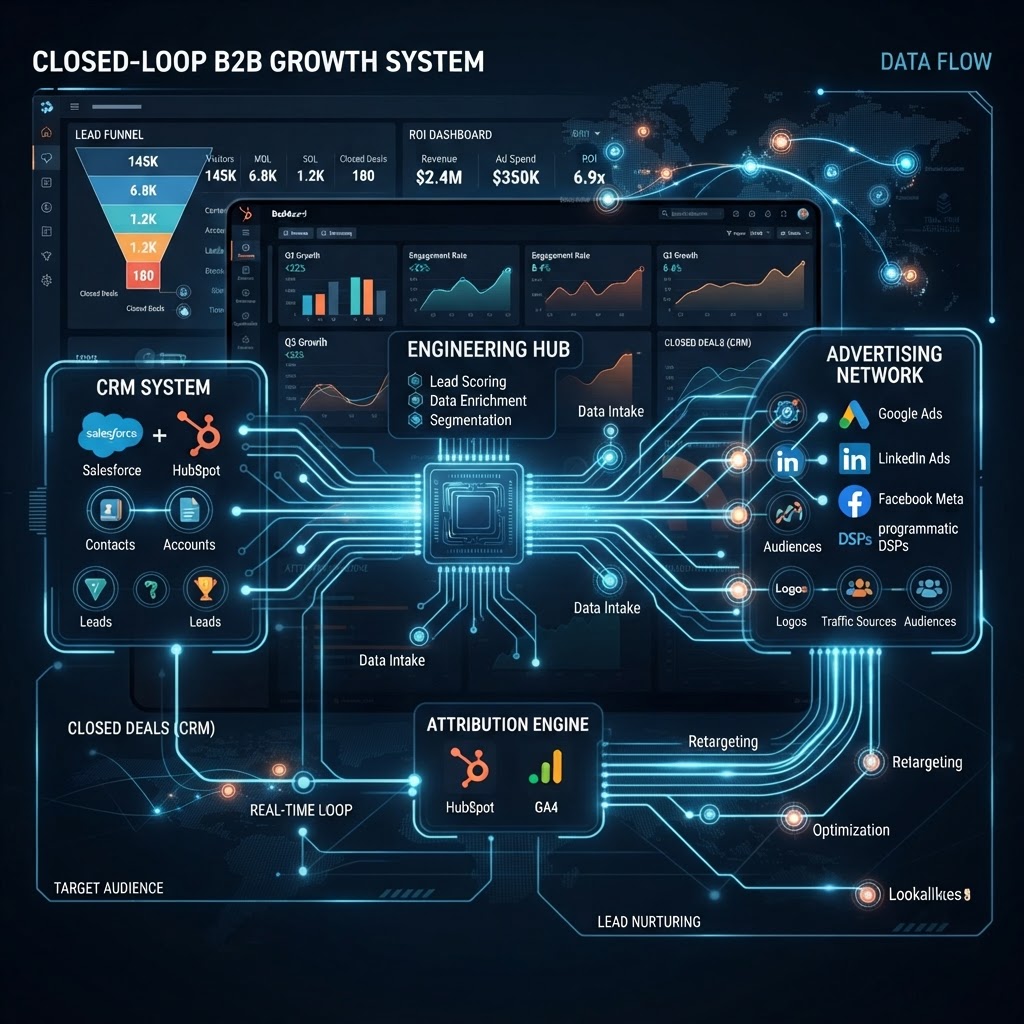
Stop treating performance marketing as a creative art and start treating it as a technical engineering problem. Discover how a closed-loop feedback system reduces acquisition costs and drives SQLs for B2B SaaS, Manufacturing, and Healthcare.
The Engineering-Led Performance Engine: Why B2B Growth Fails Without a Closed-Loop Feedback System
In the high-stakes sectors of B2B SaaS, heavy manufacturing, and specialized healthcare, the margin for error in digital growth is narrowing. With B2B sales cycles averaging 379 days in 2024, the traditional 'spray and pray' model of digital advertising isn’t just inefficient—it is a liability. For these industries, marketing is no longer a purely creative endeavor; it is a systems engineering problem.
At 1976.cloud, we view performance marketing through the lens of technical infrastructure. The primary reason most B2B demand generation programs plateau or fail is the absence of a 'closed-loop' feedback system. When your ad platforms are disconnected from your CRM, your bidding algorithms are essentially flying blind. To reduce acquisition costs and scale predictably, firms must shift from ad-hoc testing to an engineering-led engine that feeds high-intent data back into the machine.
Beyond the Creative Myth: The 3-3-3 Framework
Most agencies approach creative testing as a game of intuition. They launch a few ads, see what 'feels' right, and pivot based on surface-level metrics like Click-Through Rate (CTR). In complex B2B environments, CTR is a vanity metric. A high CTR from the wrong audience is simply a faster way to burn your budget.
We implement a systematic 3-3-3 Framework to isolate variables with scientific precision. This involves testing 3 distinct concepts (e.g., pain-point focused, feature-focused, and social proof-focused), 3 visual variations for each concept, and 3 specific 'hooks' or headlines. By isolating these elements, we can identify exactly which combination resonates with a Director of Engineering or a Hospital Administrator. This isn't just about finding a 'winner'; it’s about building a data-backed library of what works, allowing us to replicate success across different product lines.
The 31% Advantage: Implementing Offline Conversion Tracking (OCT)
The gap between a 'lead' (a form fill) and a 'Sale' (closed-won revenue) is where B2B marketing budget goes to die. If your Google and Meta algorithms only see the lead submission, they will optimize for volume, often attracting low-quality traffic that wastes your sales team's time. This is the 'Garbage In, Garbage Out' (GIGO) risk.
Engineering a closed-loop system requires Offline Conversion Tracking (OCT). By building technical pipes that feed high-intent CRM data—such as Sales Qualified Leads (SQLs) or Opportunity stages—back into the ad platforms, we give the AI the signal it needs to find more buyers, not just more browsers. Research indicates that B2B SaaS firms using OCT can see a 31% lower cost per lead by focusing the algorithm on value rather than volume. At 1976.cloud, our engineers handle the API integrations and server-side tracking necessary to make this a reality, ensuring your paid media management is fueled by actual revenue data.
Combating Creative Fatigue in Niche Segments
In Manufacturing and Healthcare, the total addressable market (TAM) is often smaller and more concentrated than in B2C. When you are targeting a specific niche of medical device procurement officers, you hit frequency caps fast. Traditional monthly creative updates are too slow; by the time you refresh your ads, your audience has already tuned them out, causing CPL to spike.
To combat this, we utilize automation-led creative refreshes every 10-14 days. This doesn't mean reinventing the wheel every two weeks; it means using our engineering-led approach to swap headlines, background visuals, and calls-to-action based on the performance data from the previous cycle. This rapid iteration ensures that your B2B demand generation remains fresh and high-performing even in narrow market segments.
Shifting to Value-Based Bidding
Once the technical infrastructure is in place, we move our clients away from standard automated bidding to Value-Based Bidding (VBB). Instead of telling Google 'get me a lead for $100,' we tell the platform 'this specific lead is worth $5,000 because they fit our Ideal Customer Profile (ICP), while this other lead is worth $0.' This level of granularity allows the ad platform to bid aggressively for high-value targets while pulling back on low-intent traffic. It aligns your marketing spend directly with your financial goals, transforming performance marketing from a cost center into a predictable revenue driver.
Compliance and Security: The Healthcare and Manufacturing Standard
We recognize that for our Healthcare clients, data engineering must be balanced with strict privacy standards. Implementing tracking loops in a HIPAA-compliant environment requires a level of technical sophistication that most creative agencies lack. We focus on server-side tagging and anonymized data hashing to provide the necessary signals to ad platforms without compromising patient privacy or data integrity. In Manufacturing, where proprietary processes are guarded, our systems are built to respect corporate security protocols while still extracting the growth metrics that matter.
Embedded Collaboration for Strategic Pivots
The days of waiting for a monthly PDF report are over. Strategic growth requires real-time visibility. We embed into our clients’ workflows by syncing performance data directly into shared environments like Notion and Slack. When an engineering-led engine is running, the data reveals insights daily. If a specific creative testing batch shows a sudden drop in efficiency, our team and your internal stakeholders see it simultaneously, allowing for a pivot in hours, not weeks. This collaborative, shoulder-to-shoulder approach is how we ensure our strategy remains agile and results-oriented.
Conclusion: Engineering Your Success
The B2B landscape is too complex for 'ad-hoc' marketing. To win in 2024 and beyond, you need more than just ads; you need a technical foundation that connects your front-end marketing to your back-end revenue. By treating performance marketing as a closed-loop engineering problem, 1976.cloud helps B2B SaaS, Manufacturing, and Healthcare companies scale with precision, reduce acquisition costs, and dominate their categories.
Ready to build your growth engine? Get Started Today - https://1976.cloud