The Creative Velocity Gap: Engineering a Systematic Testing Lab to Solve the B2B CAC Crisis
July 29, 2026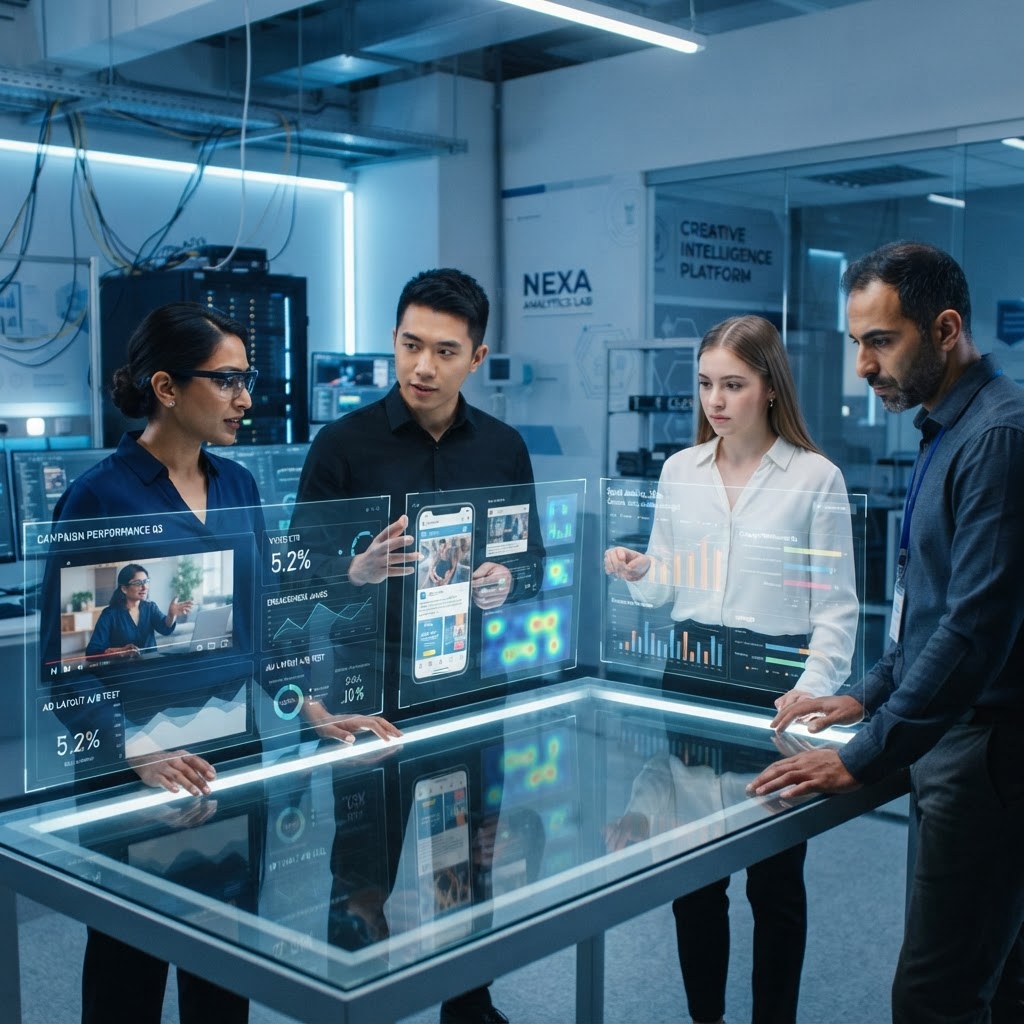
With B2B acquisition costs climbing and traditional targeting losing its edge, creative has become the primary lever for growth. Learn how 1976.cloud’s modular 'Scientific Lab' approach uses engineering principles to solve the B2B CAC crisis.
The Era of Precision Targeting is Over; The Era of Creative Engineering has Begun
For years, B2B marketers relied on the surgical precision of platform targeting. You could find a VP of Operations at a mid-market manufacturing firm with a specific interest in lean methodology, and you could serve them an ad with reasonable confidence. However, privacy updates, the deprecation of third-party cookies, and the shift toward black-box algorithmic bidding have effectively neutralized the advantage of granular targeting. Platforms like LinkedIn, Meta, and Google now use AI to find your audience; the only lever left to pull is the creative itself.
Today, creative assets have replaced audience segmentation as the primary mechanism for performance marketing. Yet, while targeting has become automated and sophisticated, the way most B2B firms approach creative remains stubbornly manual, subjective, and slow. This is what we call the 'Creative Velocity Gap'—and it is the primary driver of the current B2B CAC crisis.
The $1,200 Benchmark: Why Your Customer Acquisition Cost is Skyrocketing
According to the latest B2B SaaS Customer Acquisition Cost Benchmarks, the average CAC for SaaS has climbed to over $1,200. Simultaneously, sales-led cycles are approximately 14% longer than they were just a year ago. In technical sectors like Manufacturing and Healthcare, these figures are often even more punishing due to the complexity of the buying committee and the high stakes of the procurement process.
When acquisition costs rise and sales cycles lengthen, the traditional agency model—where a creative team goes into a 'black box' for six weeks to produce a single hero video—fails. By the time that asset is live, the market has shifted, or the message misses the mark, wasting thousands in paid media management. To reduce acquisition costs, B2B firms must stop treating creative as subjective art and start treating it as an engineered asset.
The Scientific Lab: Engineering Creative with the 3-3-3 Modular Framework
At 1976.cloud, we operate less like a traditional agency and more like a scientific testing lab. We don’t guess which message will resonate with a surgical procurement officer or a SaaS CTO; we engineer tests to find out. Our core methodology is the 3-3-3 Modular Framework, a systematic approach to high-velocity creative testing.
1. Three Distinct Angles (The Strategy)
We begin by identifying three fundamental value propositions. In Manufacturing, this might be Cost Reduction, Compliance/Safety, and Throughput Efficiency. These are not just copy changes; they are entirely different psychological entries into the prospect’s problem space.
2. Three Visual Variations (The Environment)
We test the 'shell' of the ad. This could include a high-production product demo, a simplified 2D motion graphic explaining the workflow, or a 'user-generated' style video from a subject matter expert. The goal is to see which visual medium earns the most attention in a crowded feed.
3. Three Specific Hooks (The Interaction)
The first three seconds of a video or the first line of an ad are the most critical. We test three different 'hooks' for every variation. Does a provocative question perform better than a startling statistic? The data tells us the truth, often contradicting the 'gut feeling' of the creative director.
By deploying these 27 combinations (3x3x3) in a controlled environment, we identify 'unicorn' ads—those rare assets that outperform the baseline by 3x or 5x. These unicorns are what ultimately drive down CAC and fuel B2B demand generation.
Modular Creative for Complex Industries: Healthcare and Manufacturing
The 'Scientific Lab' approach is particularly vital for technical sectors. In Healthcare, for instance, a single software solution might be sold to both a Chief Medical Officer and a Head of IT. Their pain points are diametrically opposed: one cares about patient outcomes, the other about data security and interoperability.
Instead of building separate, expensive campaigns for each, our modular approach allows us to swap 'blocks' of creative. We can use the same core product visualization but swap the hook and the closing call-to-action to speak directly to different stakeholders. This speed-to-market is what allows our partners to outmaneuver larger, slower competitors.
Solving the Feedback Loop: The 1976.cloud Embedded Model
One of the greatest risks to a performance marketing engine is 'creative fatigue'—the point where an audience has seen an ad so often it no longer registers. In the old model, fixing this required a new contract, a new brief, and weeks of waiting. The feedback loop was broken.
We solve this through embedded collaboration. Our performance engineers and creative teams operate under one roof, integrated directly into our clients' workflows via Slack and Notion. When the data shows a hook is starting to fatigue on a Tuesday, a new variation is engineered, approved, and live by Thursday. We don't wait for monthly reporting calls to make strategic pivots; we move at the speed of the algorithms we manage.
Focusing on Pipeline, Not Vanity
A common pitfall in B2B creative testing is optimizing for Click-Through Rate (CTR). In high-value B2B, a high CTR can actually be a negative indicator if it’s attracting 'trash' leads that clog up the sales pipeline. At 1976.cloud, our lab is calibrated for pipeline value.
Because we work shoulder-to-shoulder with internal stakeholders, we track our creative tests all the way through the CRM. If 'Angle A' has a lower CTR but a 20% higher conversion rate to Qualified Lead, our engineering mindset dictates that we double down on 'Angle A.' We are not looking for the most popular ad; we are looking for the most profitable one.
Conclusion: Closing the Velocity Gap
The B2B CAC crisis isn't going away. As AI continues to automate the 'math' side of media buying, the 'magic' side—creative—must become more scientific to compensate. By adopting a high-velocity, modular testing framework, B2B SaaS, Manufacturing, and Healthcare companies can stop guessing and start growing.
If your creative process feels more like an art gallery than a laboratory, you are likely leaving significant growth on the table. It’s time to bridge the gap between engineering and execution.
Ready to transform your creative into a data-backed growth engine?